
Introduction
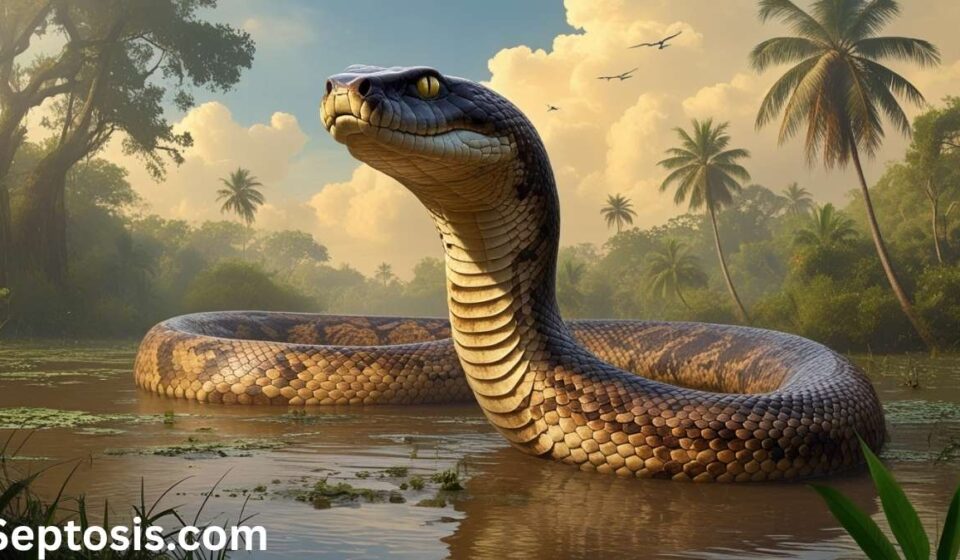
Imagine a snake longer than a school bus. Does that sound like a monster movie? Well, it was real. Scientists recently discovered a massive ancient snake in India. Its name is Vasuki Indicus. This giant reptile slithered through warm forests about 47 million years ago. If you love dinosaurs or cool animal facts, you are in the right place. Let’s dig into the story of this unbelievable “snake king.”
What Exactly is Vasuki Indicus? (Featured Snippet)
Vasuki Indicus is an extinct species of giant madtsoiid snake discovered in Gujarat, India. It lived roughly 47 million years ago during the Eocene epoch.
- Size: Estimated between 36 to 50 feet long.
- Weight: Similar to a large adult elephant (over 1,000 kg).
- Family: A distant cousin of modern pythons and cobras.
The Discovery: How Did We Find This Giant Snake?
Scientists found the fossils in 2005, but the research was just published recently. They uncovered 27 well-preserved backbone pieces (vertebrae) in a coal mine in Gujarat.
Where Was It Found?
The fossils came from the Panandhro Lignite Mine in western India. This area used to be a hot, swampy forest.
Why Is the Name Special?
The name Vasuki Indicus honors Hindu mythology. In old stories, Vasuki is a powerful serpent king around Lord Shiva’s neck. “Indicus” simply means “from India.” So, the snake is literally the “Indian Serpent King.”
How Big Was Vasuki Indicus Compared to a T-Rex?
This is the fun part. People often ask, “Could it eat a dinosaur?” Let’s look at the numbers.
| Feature | Vasuki Indicus | Tyrannosaurus Rex (T-Rex) |
|---|---|---|
| Length | 36–50 feet (Very long) | 40 feet (Similar length) |
| Weight | ~1,000 kg | ~7,000 kg (Much heavier) |
| Body Shape | Broad, wide, like a large python | Thick, muscular legs & tail |
| Attack Style | Constriction (squeezing) | Bone-crushing bite |
Key Insight: While it was as long as a T-Rex, Vasuki Indicus was much skinnier. It was built like a modern anaconda, not a tank.
What Did This Giant Snake Eat?
Because the snake’s mouth wasn’t huge like a dinosaur’s, it didn’t “unhinge” its jaw to swallow a human. Instead, Vasuki Indicus was a constrictor.
- How it hunted: It wrapped its heavy body around prey and squeezed until the animal couldn’t breathe.
- The Menu: It likely ate crocodiles, giant turtles, and fish. Remember, 47 million years ago, crocodiles were smaller than they are today!
Pro Tip: Look at the shape of the vertebrae. Scientists can tell it was a constrictor because the bones are thick and strong for muscle attachment, not flexible like a tree snake.
Life in the Eocene: The World of Vasuki Indicus
To understand this snake, you need to understand its home. The Eocene epoch was very hot.
- Climate: Greenhouses with no ice at the poles.
- Neighbors: It lived alongside crocodiles, early rhinos (small ones), and giant tortoises.
- Environment: Thick, wet forests with large rivers.
This heat allowed cold-blooded snakes to grow massive. The warmer the weather, the bigger the reptile.
Why Did Vasuki Indicus Go Extinct?
Sadly, the “Serpent King” doesn’t rule anymore. Scientists believe climate change was the cause.
- Cooling Planet: The Earth started getting cooler and drier.
- Forests Shrunk: Thick jungles turned into grasslands.
- Food Shortage: Large snakes need large prey and high humidity to survive.
When the environment changed, Vasuki Indicus couldn’t adapt quickly enough. However, its smaller cousins (modern pythons) survived.
Fun Facts to Share with Your Friends (Bullet Points)
- It is named after the same snake god that sits on Lord Shiva’s neck.
- It is one of the largest snakes ever discovered, rivaling the famous Titanoboa.
- Unlike the movie Anaconda, this snake was not a fast swimmer; it was a slow, ambush predator.
- The fossils were hiding in a coal mine for 20 years before scientists fully studied them!
How Does This Help Science Today?
Studying Vasuki Indicus isn’t just about monsters. It helps us understand climate change.
- Paleontology Lesson: Giant reptiles tell us the past was much hotter.
- Future Prediction: By knowing how heat affects snake size, scientists can predict how modern animals might react to global warming.
Conclusion: The Legacy of the Serpent King
Vasuki Indicus is more than just a big snake. It is a time machine. It proves that India was once a land of giants. While you don’t have to worry about stepping on a 50-foot snake today, this discovery reminds us how powerful nature is. Climate change killed the giants once. It could happen again.
Your Turn: Did this article make your skin crawl or spark your curiosity? Share it with a friend who loves dinosaurs. Click here to read more about ancient animals or leave a comment below asking “What would you name a giant snake?”
Want More Amazing Discovery Stories?
If you enjoyed learning about ancient giants, you will love modern mysteries. Check out our article on another fascinating personality: Who is Kelsy Ully?
Frequently Asked Questions (FAQs)
1. Is Vasuki Indicus still alive today?
No. It is completely extinct. It lived 47 million years ago. There are no giant snakes like this in modern India.
2. Could Vasuki Indicus eat a human?
Technically, yes, it could squeeze a human. However, humans did not exist 47 million years ago! We evolved much later.
3. Who is bigger: Titanoboa or Vasuki Indicus?
Titanoboa was heavier and slightly longer (42–49 feet). Vasuki Indicus was similar in length but had a wider, flatter body. It is a close tie!
4. Is this snake related to the Indian Cobra?
Distantly. Vasuki Indicus belongs to an extinct family called Madtsoiidae. Cobras are in the Elapidae family. Think of them as great-great-great uncles, not direct grandparents.
5. Where can I see the fossils?
The fossils are currently in scientific collections. You might see replicas in the future at the Indian Museum in Kolkata or the Geological Survey of India.
6. How do scientists know its size from just bones?
They measure the width of the backbone (vertebrae). A known rule in biology says: “Wider bones = bigger body.” They compare the fossil to living pythons to calculate the length.