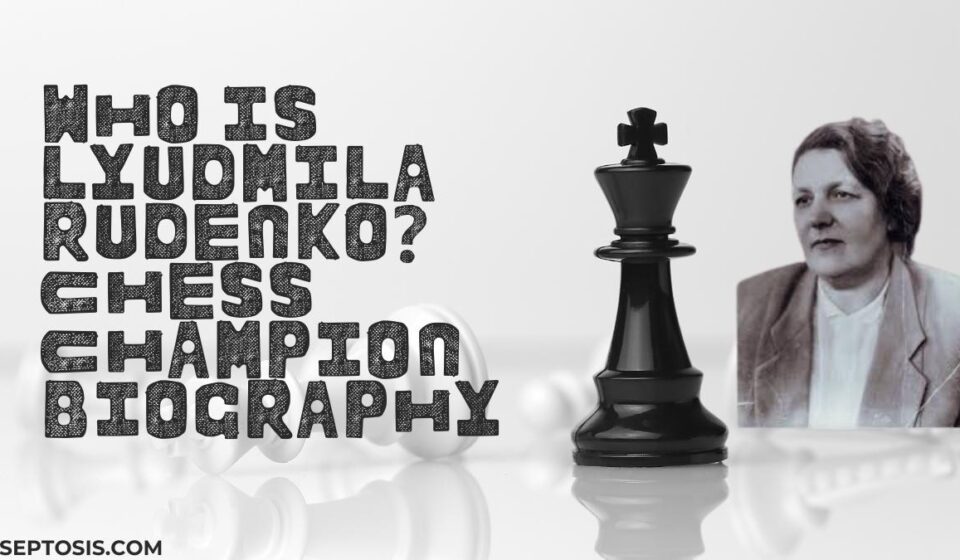

Who Is Lyudmila Rudenko?
Introduction to Lyudmila Rudenko
If you explore the history of chess, you will eventually come across the name Lyudmila Rudenko, one of the pioneers of women’s competitive chess. She was not just another strong player; she became the second Women’s World Chess Champion, holding the title from 1950 to 1953. Her journey into chess greatness is both inspiring and unusual because she entered top-level competition relatively late compared to many champions.
Lyudmila Vladimirovna Rudenko was born on 27 July 1904 in Lubny, which was then part of the Russian Empire and is now located in Ukraine. She later became a prominent chess player representing the Soviet Union. Rudenko’s achievements helped shape the early era of international women’s chess competitions.
What makes her story truly fascinating is that chess was not even her first passion. She initially focused on swimming and academics before seriously pursuing chess. Yet despite starting later, she managed to defeat strong competitors and claim the world championship title.
Her life story is not only about chess. During World War II, she played a heroic role in helping evacuate children from the Siege of Leningrad, proving that her legacy extends far beyond the chessboard.
Early Life and Childhood
Lyudmila Rudenko’s early life played a significant role in shaping the disciplined and determined personality that later defined her chess career. Growing up in a modest environment in Lubny, she was introduced to intellectual thinking and strategic games from a young age.
Family Background and Education
Rudenko’s father was a government official who later worked as a lawyer and eventually became a priest during turbulent political times. Despite the changing political landscape of the early 20th century, education remained important in the household.
Lyudmila showed strong academic abilities and later studied economics in Odessa, a major cultural and educational center in the region. Her academic training helped develop the analytical thinking that would later benefit her chess strategy.
Even though chess was present in her childhood, it was not initially considered a serious career path. At that time, competitive chess opportunities for women were limited, and very few female players gained international recognition.
Early Interest in Chess and Swimming
Interestingly, chess was not Rudenko’s primary focus during her teenage years. She was actually more passionate about swimming, where she achieved impressive results. She even became the vice-champion of Ukraine in breaststroke swimming.
Her father taught her how to play chess at the age of 10, but it remained just a hobby for many years. This casual introduction later turned into a lifelong passion.
This dual background in sports and academics gave Rudenko a balanced personality. She developed the competitive mindset of an athlete and the strategic thinking of a scholar — a powerful combination that later helped her dominate in chess competitions.
How Lyudmila Rudenko Started Her Chess Career
The turning point in Lyudmila Rudenko’s life came when she moved to Moscow in the mid-1920s. This relocation exposed her to a vibrant chess culture where strong players gathered regularly to compete and train.
First Chess Tournaments
Rudenko began participating in chess tournaments around 1925–1926. These early competitions were crucial in building her confidence and sharpening her skills. At first, she was known for an aggressive and creative playing style, often willing to sacrifice pieces to create complicated positions.
In 1928, she achieved a major milestone by winning the Moscow Women’s Chess Championship, defeating several strong players. This victory helped establish her reputation as a rising talent in Soviet chess circles.
However, success did not come easily. Rudenko’s style was sometimes considered risky, and she occasionally lost games due to overly bold sacrifices. Friends and fellow players often advised her to analyze positions more carefully before making aggressive moves.
Despite these challenges, her talent was undeniable. When she was in good form, opponents found it extremely difficult to stop her.
Rise in Soviet Chess Circles
Later, Rudenko moved to Leningrad (now Saint Petersburg), where women’s chess had a strong community and competitive structure. Chess clubs were active, and tournaments were held regularly.
There she trained with respected chess masters and improved her positional understanding. Over time, she became a consistent competitor and won the Leningrad Women’s Championship three times, strengthening her reputation as one of the strongest female players in the Soviet Union.
Her progress was gradual but steady, proving that determination and continuous learning can transform a talented amateur into a world-class professional.
Major Achievements in Chess
Lyudmila Rudenko’s greatest achievements came in the late 1940s and early 1950s when she reached the peak of her career. Her victories during this period established her as one of the most important figures in women’s chess history.
Winning the Women’s World Chess Championship
The opportunity to compete for the Women’s World Chess Championship arose after the death of the previous champion Vera Menchik in 1944. The international chess federation organized a tournament in Moscow during 1949–1950 to determine the new champion.
Sixteen players from twelve countries participated in the competition. Many experts initially believed that other Soviet players were stronger contenders.
Yet Rudenko surprised everyone.
At the age of 45, she delivered a remarkable performance, scoring 9 wins, 1 loss, and 5 draws, finishing first in the tournament and becoming the second Women’s World Chess Champion.
Her victory proved that experience and deep understanding of the game can outweigh youth and speed.
Soviet Women’s Championship Victory
Rudenko’s success continued in 1952, when she won the USSR Women’s Chess Championship, another prestigious title in the highly competitive Soviet chess environment.
The Soviet Union was famous for producing strong chess players, and the national championship often featured world-class competitors. Winning this event confirmed that her world championship victory was no accident.
However, in 1953, Rudenko lost her world championship title to Elisaveta Bykova in a closely contested match.
Even though she lost the crown, her impact on the chess world remained significant.
Lyudmila Rudenko During World War II
One of the most remarkable chapters in Rudenko’s life had nothing to do with chess.
During World War II, the city of Leningrad faced one of the most devastating sieges in history. Millions of civilians were trapped as the city struggled to survive.
Evacuating Children from the Siege of Leningrad
In this dangerous situation, Rudenko took action that demonstrated extraordinary courage and compassion.
She helped organize a train evacuation for hundreds of children, ensuring they were transported safely away from the besieged city. This mission saved many young lives during one of the darkest periods of the war.
Interestingly, Rudenko later said that this humanitarian act was the most important achievement of her life, even more meaningful than becoming world chess champion.
This statement reveals a powerful lesson: while titles and trophies are impressive, helping others can create a legacy that lasts far longer.
Playing Style and Strengths
Lyudmila Rudenko was known for her distinctive and fearless approach to chess. Her style combined creativity, tactical sharpness, and growing strategic understanding.
Tactical Creativity
Early in her career, Rudenko was famous for bold attacks and surprising sacrifices. She enjoyed creating complicated positions that forced opponents to calculate deeply.
This aggressive style made her games exciting to watch. Many spectators admired her willingness to take risks in order to gain attacking chances.
However, boldness also came with disadvantages. Some of her sacrifices were considered premature or unnecessary.
Strategic Improvements Later in Career
As she gained experience, Rudenko improved her positional play and defensive skills. She worked with well-known chess trainers such as Alexander Tolush and Grigory Levenfish, who helped refine her understanding of the game.
By combining tactical creativity with solid strategy, she became a more balanced and dangerous competitor.
This transformation played a key role in her world championship victory.
Titles and Honors
Lyudmila Rudenko achieved several important titles during her chess career.
| Title | Year Achieved |
|---|---|
| International Master (IM) | 1950 |
| Woman International Master | 1950 |
| Woman Grandmaster (WGM) | 1976 |
| Women’s World Chess Champion | 1950–1953 |
She also made history by becoming the first woman ever awarded the International Master title by FIDE.
These honors demonstrate the lasting respect she earned within the global chess community.
Personal Life and Challenges
Outside chess, Rudenko lived a life filled with both professional and personal responsibilities.
Family Life and Career Balance
She married Lev Goldstein, a scientist working in the field of cybernetics. The couple had a son together and lived in Leningrad.
Balancing family life with competitive chess was not easy, especially during a time when professional opportunities for female players were limited.
Rudenko also worked as an economic planner for the Soviet government while developing her chess career. Managing both roles required strong discipline and time management.
Later in life, she suffered severe vision problems that eventually caused her to lose most of her eyesight. Despite this challenge, she remained passionate about chess until the end of her life.
Legacy and Impact on Women in Chess
Lyudmila Rudenko’s achievements helped open doors for future generations of female chess players.
Her world championship victory demonstrated that women could compete at a high strategic level and achieve global recognition in the chess world.
Many later champions, including Soviet and international players, benefited from the path she helped create.
Her story also highlights the importance of persistence. She reached her greatest success in her mid-40s, proving that it is never too late to achieve greatness.
Recognition and Hall of Fame
Long after her competitive career ended, Rudenko’s contributions continued to be celebrated.
In 2015, she was inducted into the World Chess Hall of Fame, honoring her achievements and influence on the game.
Additionally, Google honored her with a Google Doodle in 2018, celebrating the 114th anniversary of her birth and introducing her story to a global audience.
These recognitions show how her legacy continues to inspire chess players around the world.
Conclusion
Lyudmila Rudenko was far more than a chess champion. She was a pioneer, a strategist, and a humanitarian who helped shape the early history of women’s chess. Born in 1904, she rose from a casual chess enthusiast to become the second Women’s World Chess Champion, holding the title from 1950 to 1953.
Her life proves that success is not always about starting early or following a traditional path. Rudenko balanced family life, professional work, and competitive chess while overcoming personal and historical challenges.
Perhaps the most inspiring part of her story is her humanity. Saving children during World War II showed the same courage and determination she displayed on the chessboard.
Today, she remains an enduring symbol of resilience, intelligence, and compassion — a true legend in the history of chess.
FAQs
1. Who is Lyudmila Rudenko?
Lyudmila Rudenko was a Soviet chess player who became the second Women’s World Chess Champion, holding the title from 1950 to 1953.
2. When was Lyudmila Rudenko born?
She was born on 27 July 1904 in Lubny, in the Poltava region of the Russian Empire (now Ukraine).
3. What titles did Lyudmila Rudenko achieve?
Rudenko earned the titles of International Master (1950) and Woman Grandmaster (1976) and won the USSR Women’s Chess Championship in 1952.
4. What did Lyudmila Rudenko do during World War II?
She organized a train evacuation that helped save hundreds of children from the Siege of Leningrad.
5. Why is Lyudmila Rudenko important in chess history?
She helped shape early international women’s chess competitions and inspired future generations of female players.