
“AI spots cancer years before doctors” makes a wonderful headline. In fact, headlines like that now appear almost every month. Some of them are based on real, careful science. Others stretch one small study a very long way. So what can AI detect cancer early actually do today — and what can it not do?
The honest answer sits in the middle. AI is already helping doctors find more cancers in breast screening, lung scans and bowel tests. However, it works as an assistant, not as a doctor. It flags things for a human to check. Meanwhile, other tools that sound just as impressive — phone apps for moles, or blood tests that claim to find fifty cancers at once — come with much bigger question marks. This guide walks through the evidence, area by area, in plain English.
Quick verdict: AI can help detect some cancers earlier, mainly by acting as a tireless second pair of eyes on scans and images. The strongest proof so far is in breast screening. Even there, a person makes the final call. No AI tool, app or blood test should replace proper screening or a doctor’s judgement. If you remember one line, make it that one.
This article is general information only, not medical advice. If you have a symptom that worries you — a new lump, a changing mole, unexplained bleeding, a cough that will not go — see a GP promptly. Do not wait for an app or a test to give you permission.
Breast Screening: The Strongest Evidence So Far
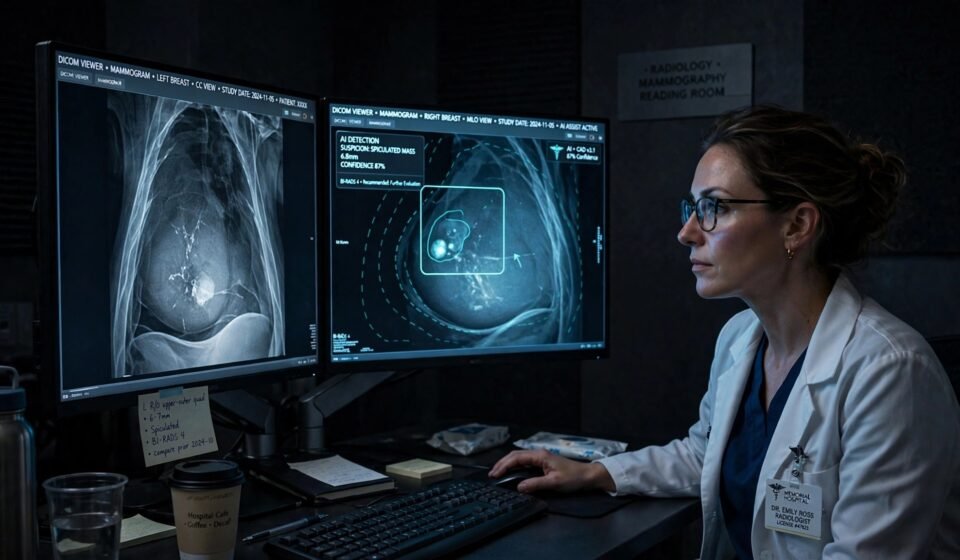
Mammograms are X-ray pictures of the breast. They are also ideal training material for AI, because screening programmes hold millions of past images with known outcomes. So it is no surprise that breast screening produced the first really strong results.
The landmark study is called MASAI. In Sweden, researchers randomly split more than 105,000 women between standard screening and screening supported by AI. Under standard screening, two radiologists read every mammogram. In the AI arm, the software scored each scan, and most low-risk scans needed only one human reader. The results were striking. AI-supported screening found about 29% more cancers — 6.4 per 1,000 women, compared with 5.0 per 1,000. At the same time, it cut the reading workload by about 44%. Crucially, it did this without a significant rise in false alarms.
A later MASAI report checked cancers that surfaced between screening rounds. These “interval cancers” are the ones screening most wants to avoid. The AI group had slightly fewer of them, and the cancers that did appear were less often large or aggressive. Sensitivity — the share of cancers the system caught — was also higher with AI: 80.5%, compared with 73.8% for standard reading. In short, the AI did not just work faster. It missed less.
British evidence points the same way. In the AIMS study, researchers tested a Google AI system on more than 115,000 mammograms from five NHS screening services. The AI was more sensitive than a single human first reader. It also helped raise the detection rate from 7.54 to 9.33 cancers per 1,000 women. It even flagged a quarter of the interval cancers that humans had missed. A live trial run at twelve sites then showed the software could work inside real clinics. However, it also showed something important: the settings that worked on old data needed adjusting on live data. AI, in other words, needs local tuning and watching, not blind trust.
None of this means a computer reads your mammogram alone. In every successful study, radiologists stayed in charge. The AI sorted, scored and pointed. Humans decided.
Lung Scans: A Second Reader That Rarely Tires
Lung cancer screening uses low-dose CT scans for people at higher risk, such as long-term smokers. Each scan contains hundreds of images. A tiny lung nodule — a small spot that might, or might not, matter — can hide in any of them. Radiologists are good at this search, but it is slow, tiring work.
AI helps in two ways. First, it marks possible nodules so fewer get missed. Second, it measures nodules and compares them with earlier scans, so growth is easier to judge. In a reader study using difficult scans, many of them early-stage cancers from a major US screening trial, radiologists working with AI saw their detection sensitivity rise from about 59% to about 73%. They also finished each scan about 13% faster. A separate real-world trial in 2025 added a similar finding: with AI support, doctors reported more nodules that needed action. The trade-off was more follow-up scans.
That trade-off is the honest summary for lung AI. It finds more spots. However, most spots are harmless, so finding more also means more repeat scans, more waiting and more worry. The evidence that AI lung screening saves more lives than lung screening alone is still being gathered. For now, it is best described as a promising assistant inside a proven programme — not a proven improvement on its own.
Skin Cancer Apps: Real Promise, Real Warnings
Skin cancer apps sound perfect. You photograph a mole, the app rates the risk, and you relax — or book a doctor. By contrast with hospital AI, though, the evidence here is much weaker.
In 2020, a team reviewed the research for The BMJ. They found just nine studies covering six apps, and the studies were small and flawed. Clinicians, not ordinary users, had chosen and photographed the moles. Researchers simply left out many unclear photos. One app, in its only study, failed to flag any of five melanomas. The best-studied app still missed roughly one in eight cancerous or precancerous moles in one study. The reviewers’ verdict was blunt: these apps cannot be relied on to detect all skin cancers, and the rules that allowed them onto the market did not protect the public well enough. In the United States, no skin-cancer assessment app has FDA approval.
There is a brighter side, but it sits inside clinics, not app stores. Clinics use systems such as DERM within NHS-style pathways, where trained staff take standard photos and doctors stay involved. Those regulated, supervised tools are a different product from a consumer app giving you a risk score in your kitchen. Meanwhile, AI trained on skin images raises another problem: most training photos show lighter skin. Performance on darker skin tones is less certain, because the data is thinner. A tool that works unevenly across skin tones is not a safe gatekeeper for everyone.
So treat any app result as a nudge, never as an all-clear. A changing, growing, bleeding or unusual mole needs a GP, whatever your phone says.
Blood Tests for Many Cancers: Exciting, but Not There Yet
The boldest idea in this field is the multi-cancer blood test. Cancers shed tiny fragments of DNA into the blood. A test called Galleri, made by GRAIL, looks for a shared signal in that DNA. One blood draw, the claim goes, can screen for more than fifty types of cancer — including pancreatic and ovarian cancers, which have no routine screening test today.
What have the trials shown? In the US PATHFINDER study, about 6,600 adults over fifty took the test. It found a cancer signal in 1.4% of them, and about 38% of those people were indeed diagnosed with cancer after further checks. The test was very good at not crying wolf: false alarms were rare, under 1%. However, the flip side matters just as much. Most cancers that appeared during the study were not flagged by the test, especially at the earliest stages, when treatment helps most. In validation work, the test caught only about one in six stage I cancers.
The biggest test came in England. The NHS-Galleri trial involved more than 140,000 people aged 50 to 77. Its main goal was to show that testing reduced the number of cancers found at a late stage. The trial did not meet that main goal. There were some encouraging details — fewer stage IV diagnoses, more early-stage ones — but no clear overall shift, and no proof yet that the test saves lives. As a result, Galleri is not standard NHS care. In the US, GRAIL sells it as a laboratory test without full FDA approval, and the maker itself says it should sit alongside normal screening, never replace it.
In short: a real scientific achievement, a genuinely new idea, and still an unfinished one. If a clinic offers you such a test, ask what a positive result would actually trigger, and what a negative result does not rule out.
Bowel Screening: AI as a Spotter During the Camera Test
A colonoscopy is a camera examination of the bowel. Doctors look for polyps — small growths that can turn into cancer over time — and remove them on the spot. Finding more polyps means preventing more cancers. However, even skilled doctors miss some, especially small or flat ones hiding in folds.
Computer-aided detection, or CADe, watches the live video feed alongside the doctor. When it spots something suspicious, it draws a box around it on screen. One widely used system is GI Genius. Pulled together, seven randomised trials with about 9,600 patients show that this kind of AI raises the adenoma detection rate by roughly 12% in relative terms. A large English real-world trial, NAIAD, found the same pattern in ordinary practice: detection rose from 30.0% to 34.8% while the system was switched on, then fell back after it was removed.
Two honest caveats follow. First, the extra finds are mostly small polyps, and trials have not shown a clear rise in detecting advanced growths. Second, one 2025 study raised a subtle worry: after doctors used AI for a while, their unaided detection rate dipped, as if the habit of searching had weakened. That finding needs confirming. Still, it underlines the theme of this whole guide — AI works best as a partner to a skilled human, not a substitute for one.
The Limits: What AI Still Gets Wrong
Every success above comes with fine print, and the fine print matters.
- False alarms. A flag is not a diagnosis. Follow-up scans, biopsies and months of worry can follow a wrong alarm — in PATHFINDER, people with a false-positive blood result took a median of about five months to get the all-clear.
- Missed cancers. AI still misses things, from one in six early-stage cancers in blood-test validation to melanomas an app labelled low risk. A “clear” AI result is never a guarantee.
- Overdiagnosis. Finding more is not always better. Some slow-growing cancers would never have caused harm, yet finding them leads to treatment with real side effects. More detection can mean more treatment, not just more lives saved.
- Bias in the data. AI learns from the cases it is shown. If those cases under-represent darker skin, younger patients or rarer cancers, the tool can perform worse for exactly those people.
- Study settings versus your clinic. Many results come from expert centres, selected patients or old scans read again. Real-world performance is often a step lower, as the live phase of the AIMS study showed.
- No proof of longer life, yet. For most tools, we know they change detection rates. Proof that they reduce deaths takes much longer, and for the multi-cancer blood test, the biggest trial missed its main target.
What This Means for You Today
So, can AI detect cancer early? Sometimes, with help, in specific settings — and increasingly inside the screening you are already offered. For example, if AI is used in your local breast screening unit, it quietly raises the chance that a small cancer is caught, while a radiologist still signs off the result. That is a genuine gain, and it needs nothing extra from you.
What should you actually do? Three things. First, attend screening when you are invited — in England, for instance, breast screening is offered every three years from age 50 to 71, and bowel and cervical programmes save lives today, AI or no AI. Second, act on symptoms promptly and in person; a lump, a changed mole, unusual bleeding or lasting pain deserves a GP, not an app verdict. Third, be sceptical of any product that claims to rule cancer in or out on its own. Because the tools with the best evidence all share one feature: a qualified human stays in the loop.
Frequently Asked Questions
Can AI diagnose cancer on its own?
No. In every well-tested system, AI flags, scores or sorts, and doctors investigate and decide. A diagnosis still needs human review and, usually, a biopsy or further scans. Any service that skips the doctor should worry you.
Is AI better than doctors at reading mammograms?
It is better described as different. In the MASAI trial, one reader plus AI beat two readers alone on sensitivity and workload. However, the winning team was human plus machine. The AI also needed careful setup, and its settings had to be adjusted when researchers moved from old scans to live clinics in the AIMS study.
Should I pay for a multi-cancer blood test?
That is a personal choice, but go in with clear eyes. The test rarely gives false alarms, yet it misses most early cancers, and the largest trial did not prove it reduces late-stage disease. A negative result must never replace normal screening or delay seeing a doctor about a symptom.
Can I trust a skin cancer app?
Only as a prompt to act, never as reassurance. The BMJ review found the app evidence weak and the accuracy variable, and no such app has FDA approval. If a mole is new, changing, itching or bleeding, book a GP appointment — even if an app calls it low risk.
Will AI replace radiologists?
The evidence so far says no. AI is changing the job — less time on clear scans, more time on hard cases — rather than removing it. Screening programmes are adopting it as a second reader under human control, and regulators license it that way too.
AI is also being used to spot other conditions early, long before they become emergencies. Sepsis, the body’s life-threatening reaction to infection, is one example — hospitals use pattern-spotting software to flag patients who may be deteriorating. If you want to understand the condition those systems hunt for, our sepsis guide explains the symptoms, causes and treatment in plain English.



[…] We look at the science honestly and help you tell a real breakthrough from a headline. Our article Can AI Detect Cancer Early? What the Science Actually Says is a good example of that […]