
Sepsis moves frighteningly fast. A patient can look fairly stable in the morning and be fighting for their life by the evening. Yet the condition rarely appears from nowhere. Long before the obvious crisis, small changes build up in the body. The heart beats a little faster. Blood pressure drifts down. Blood test results creep in the wrong direction.
Sepsis is the body’s extreme response to an infection, and it can lead to septic shock, organ failure and death. Worldwide, it strikes almost 50 million people a year and kills around 11 million. Our complete guide to sepsis explains how the condition develops and why it is so dangerous.
Above all, timing decides who survives. In a well-known 2006 study of patients with septic shock, survival fell by about 7.6% for each hour that effective antibiotics were delayed after blood pressure dropped. Patients treated within the first hour survived roughly eight times in ten. As a result, international guidelines now urge doctors to give antibiotics within the first hour whenever septic shock looks likely.
However, spotting sepsis early is genuinely hard. The early signs are vague, and they often mimic flu or a routine infection. Meanwhile, nurses and doctors care for many patients at once, so nobody can watch every number, all the time. So researchers asked a simple question: could a computer watch every patient continuously, and raise the alarm hours earlier? This article explores what happened when hospitals put that idea to the test.
A quick note before we start: this article offers general information only. It is not medical advice, and it cannot diagnose or treat anyone. If you think you or someone near you may have sepsis, seek urgent medical help straight away.
How AI Sepsis Prediction Works
First, it helps to understand what these systems actually do. In simple terms, an AI sepsis tool learns from the past and then watches the present. Developers train the software on the records of thousands of earlier patients. Some of those patients developed sepsis, and some did not. Gradually, the software learns which patterns of change tended to appear before sepsis began.
Next, the system goes to work on today’s patients. It reads the electronic health record as new information arrives. Typically, that includes:
- Vital signs, such as heart rate, blood pressure, temperature, breathing rate and oxygen levels
- Blood test results, including lactate and white blood cell counts
- Basic details like age, medical history and current medicines
- In some systems, the written notes of nurses and doctors
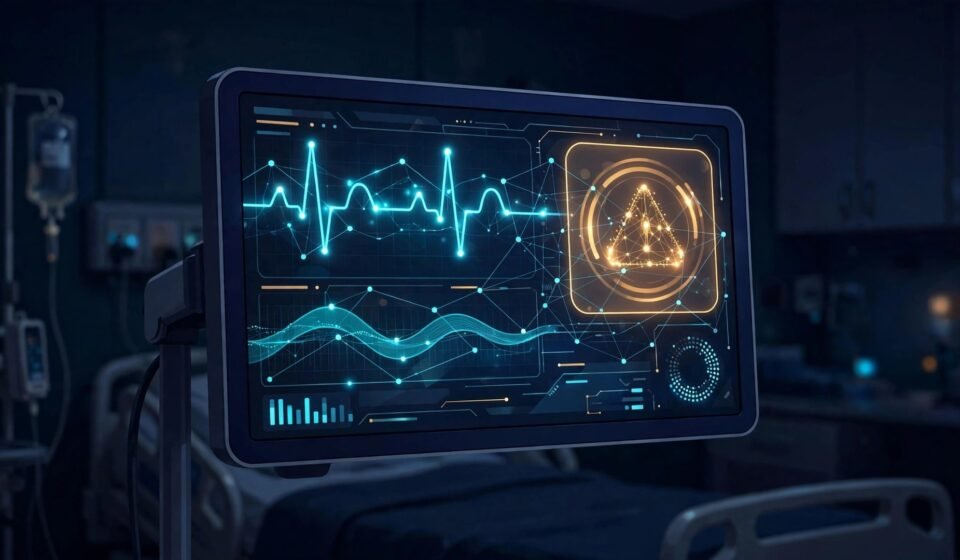
Then the software combines everything into a single risk score. The score updates whenever new data lands, sometimes every few minutes. When it crosses a set line, the system sends an alert to the care team. Basically, the message says: check this patient now, before the picture becomes obvious.
Think of it as a very patient assistant who never sleeps and never gets distracted. This assistant has also memorised thousands of earlier cases. Humans are good at noticing one big change. By contrast, algorithms excel at noticing many small changes that all point the same way. Individually, each change looks harmless. Together, they can form sepsis’s early fingerprint.
Importantly, the tool does not diagnose anyone. Instead, it prioritises. It tells busy staff whose bed to visit first, and it usually aims to give that warning a few hours before sepsis becomes clear. Whether that warning actually helps depends on what happens next, as the studies below show.
Real Systems and What the Studies Found
Dozens of hospitals now run some form of sepsis prediction software. However, the quality of evidence varies enormously. Three well-known stories show the full range, from genuinely impressive results to a cautionary failure.
TREWS: The Johns Hopkins Early Warning System
Researchers at Johns Hopkins University built TREWS, short for Targeted Real-time Early Warning System. A team led by computer scientist Suchi Saria designed it to scan patient records continuously. Whenever a patient’s pattern starts to resemble early sepsis, TREWS flags the case for staff to review.
The team then tested it at serious scale. Five hospitals used the system over two years, and it monitored more than 590,000 patients. The results appeared in the journal Nature Medicine in 2022. In particular, the researchers studied 6,877 patients with sepsis whose alert sounded before antibiotics began.
The findings were striking. When a clinician checked and confirmed an alert within three hours, those patients were 18.7% less likely to die in hospital, in relative terms, than patients whose alerts were not confirmed quickly. In absolute terms, the gap was 3.3 percentage points. Those patients also received their first antibiotic order nearly two hours sooner. Moreover, the system often flagged cases hours before usual care would have caught them, reportedly around six hours earlier in severe sepsis.
Even so, honest limits matter here. This was not a randomised trial, where patients are split into groups by chance. Instead, it compared patients whose alerts got a fast human response with patients whose alerts did not. The two groups may have differed in other ways. Still, the sheer scale of the study makes TREWS some of the strongest evidence in this field. And the deeper lesson is encouraging: the alert only helped when a person acted on it quickly.
COMPOSER: Deep Learning in the Emergency Department
Meanwhile, a team at UC San Diego Health built a deep learning model called COMPOSER. It watches more than 150 pieces of data for each patient, and it aims to predict sepsis up to four hours before onset. When the risk rises, an on-screen advisory pops up for nurses, together with clear suggested next steps.
The researchers compared care before and after they switched the system on, across two emergency departments. Their 2024 study covered 6,217 patients with sepsis. After switch-on, deaths among sepsis patients fell by 17% in relative terms, a difference of 1.9 percentage points. In addition, care teams completed the standard sepsis treatment bundle more often, with compliance rising by five percentage points.
Again, though, the design demands caution. A before-and-after study compares real results with a statistical estimate of what would have happened anyway. Other improvements in care may deserve some of the credit. Furthermore, the benefit looked clearer at one hospital than at the other. So COMPOSER is promising, but it is not final proof.
The Epic Model: A Cautionary Tale
Not every story ends so well. Epic, a major supplier of hospital record software, built a sepsis model directly into its system. Because hundreds of American hospitals use that software, the model spread widely and quietly. Epic reported strong accuracy for it, quoting scores between 0.76 and 0.83 on a common accuracy scale where 1.0 is perfect and 0.5 is no better than chance.
Then independent researchers checked. In 2021, a University of Michigan team tested the model on nearly 38,500 hospital stays at their own medical centre, and published the results in JAMA Internal Medicine. In real-world use, the accuracy score was just 0.63. At the alert level Epic recommended, the model missed 67% of patients who developed sepsis. Yet it still fired alerts during 18% of all hospital stays. Overall, only about one alert in eight pointed to a patient who truly had sepsis.
To be fair, Epic later rebuilt the model. A multicentre study in 2026 found much better accuracy scores, between 0.82 and 0.92, although false alarms remained common. Nevertheless, the original story carries the key lesson. A model is only as good as its performance in your hospital, on your patients. Independent testing matters far more than a developer’s promises.
The Limits: Why AI Is Not a Crystal Ball
False alarms cause the most obvious problem. Every alert interrupts a busy clinician, so alerts that cry wolf train staff to ignore them. Psychologists call this alert fatigue, and hospitals take it seriously. The Epic model showed why: when nearly one stay in five triggers a warning, real emergencies drown in noise.
Missed cases cause the opposite problem. Developers face an unavoidable trade-off when they set the alert threshold. A low bar catches more sepsis but floods staff with false alarms. A high bar keeps things quiet but lets more patients slip through. Consequently, every current system misses some cases, and no setting removes that risk.
Each hospital also differs from the next. A model learns local habits, such as which tests doctors order and which patients tend to arrive. Move the same model somewhere else, and its accuracy can fall sharply, as the Epic experience showed. For that reason, hospitals need to test tools on their own patients, and then keep testing them over time.
Bias creates a further concern. If past care differed between groups of patients, a model can quietly learn those patterns. People who appeared less often in the training data may then receive less accurate predictions. Responsible teams therefore check performance across ages, sexes and ethnic groups, not just overall.
Finally, the training labels themselves are fuzzy. Sepsis has no single blood test, and even experts disagree about the exact moment it starts. So the “correct answers” used to teach these systems are never perfect. Ultimately, a risk score is a prompt to check a patient. It is not a diagnosis, and it must never replace one.
What This Means for Patients
Most patients will never see these systems working. The alert appears on a staff screen, not at the bedside. What you might notice instead is the effect: a nurse rechecking you sooner, blood tests taken earlier, or antibiotics started faster. In other words, the technology works quietly in the background of your care.
Crucially, it changes nothing about what you should do. Hospital AI only watches people who have already been admitted. If you are at home and worried, your own awareness still matters most. Learn the early signs of sepsis, and seek urgent help if you spot them in yourself or a family member.
You can also simply ask your care team a fair question: does this hospital use an early-warning system? Some will describe an AI tool. Others still rely on paper scoring charts, such as the NEWS2 score used widely in the NHS, plus clinical judgement. Either way, these tools normally run inside the hospital’s own record system, on data already collected for your care.
What Comes Next
Regulation is now catching up with the technology. In April 2026, the US Food and Drug Administration cleared the commercial version of TREWS, sold by the company Bayesian Health, as a medical device. American Medicare has also agreed to pay hospitals extra for using it. Clearly, these tools are moving from research experiments to standard products that hospitals buy and must justify.
The software itself keeps improving too. Newer versions read doctors’ and nurses’ written notes, not just numbers. For example, UC San Diego’s updated system produced more accurate alerts in testing. When reviewers checked its false alarms by hand, many turned out to involve real infections anyway. Meanwhile, researchers are testing similar prediction tools for hospital patients at home, using wearable sensors.
Expectations are rising at the same time. After the Epic story, journals and regulators increasingly demand independent checks and, ideally, randomised trials. The same pattern is playing out across medicine: we recently asked whether AI can detect cancer early, and the answer there was similar. The potential is real, but proof has to come first.
Frequently Asked Questions
Can AI really predict sepsis before symptoms appear?
It predicts risk rather than certainty. The software spots patterns in your measurements that often show up a few hours before symptoms become obvious. So “before symptoms” really means before symptoms are easy to see. Many flagged patients never develop sepsis, and some genuine cases still slip through.
How many hours of warning can AI give?
It varies by system. COMPOSER was designed to predict sepsis up to four hours ahead. TREWS often flagged cases several hours earlier than usual care, reportedly around six hours in severe cases. Even one or two extra hours can matter, because antibiotics and fluids work best when they start early.
Is AI better than doctors and nurses at spotting sepsis?
Different is a fairer word than better. Computers watch every data point continuously and never tire. Clinicians, by contrast, examine the patient, understand the context and judge the whole picture. The strongest results so far come from the two working together. Remember, TREWS only helped when staff responded to its alerts quickly.
Do all hospitals use AI sepsis prediction?
No. Use is growing, especially in the United States, but only a small number of systems have strong published results behind them. Many hospitals still rely on simpler scoring charts and clinical judgement. If you are curious, ask your care team what they use.
Could an AI sepsis alert be wrong about me?
Yes, in both directions. False alarms and missed cases happen with every current system, however well it performed in studies. An alert should trigger checks, not automatic treatment. And if you feel yourself getting worse, tell staff straight away, with or without any alert.
Will AI replace hospital staff?
There is no sign of that. These tools handle the tireless watching and sorting that humans cannot sustain. Diagnosis, treatment decisions and hands-on care still belong to people. Indeed, the evidence suggests the tools achieve little without skilled staff behind them.
The Bottom Line
So, can AI predict sepsis before symptoms appear? The fairest answer is: often, yes. At their best, these systems can spot danger a few hours early, and sometimes that head start changes the outcome. At the same time, the failures show why hospitals must test these tools honestly and keep testing them. Treat the technology as a tireless extra pair of eyes, and the results make sense. The hospitals that gain most will be the ones whose people act fast when the alarm sounds.
Related Articles